







Following the events of January 3rd and the start of the new economic cycle, Venezuela’s economy took an abrupt turn. According to the research and consulting firm Ecoanalítica, which held its Perspectives forum on February 9th at the JW Marriott in Caracas, the Venezuelan economy could see double-digit annual growth rates for the next few years: a takeoff worthy of an ‘economic miracle’. And business perception reflects these expectations: in its October 2025 Economic Outlook survey, Ecoanalítica found that only 2% of firms expected a “very positive” performance in the following twelve months, while 15% anticipated negative results and more than half assumed the situation would remain the same.
But the January 2025 survey shows a dramatic shift: 79% of respondents now anticipate a positive scenario, and 13% even describe it as “very positive.” Pessimism has virtually vanished. This leap not only reflects more stable expectations following the new political and economic framework, but also suggests that, for the first time in years, the private sector perceives an environment where planning, investing, and growth once again seem possible.
The sectors that will lead the takeoff
Ecoanalítica’s projections, the leading sectors will be those closely linked to market operations: finance and insurance are at the forefront with an estimated growth of 37%, driven by increased lending activity, demand for hedging instruments, and a financial system that is beginning to regain depth. They are followed by the oil sector (20.8%) and communications (18.7%), two sectors directly benefiting from the institutional realignment following January 3rd: one through operational reactivation and the entry of new operators, and the other through accelerated investment in telecommunications and digital services.
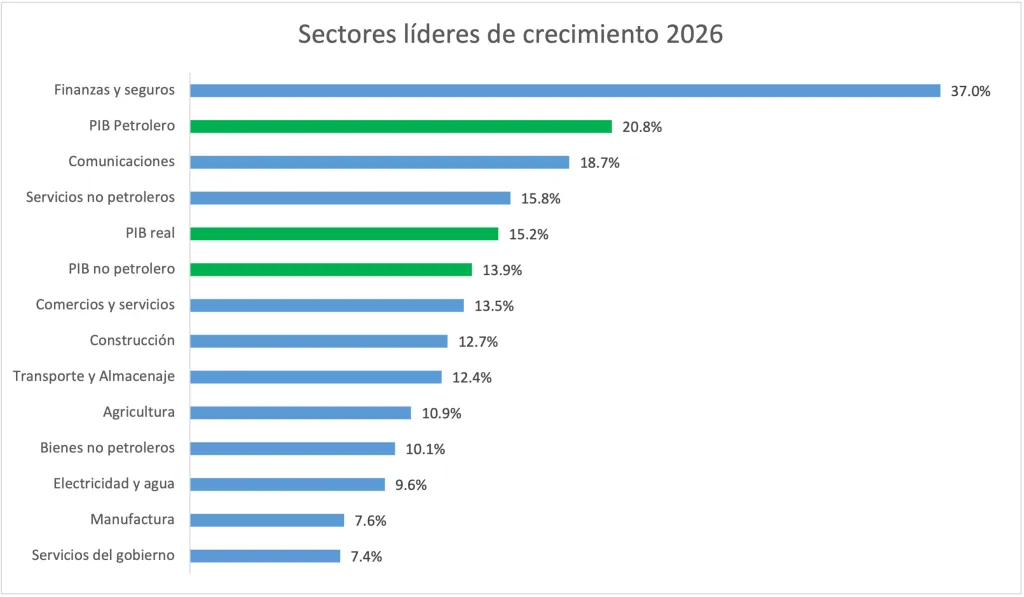
Following behind is a group of activities driven by the greater economic dynamism: non-oil services (15.8%), commerce (13.5%), construction (12.7%), and transportation/storage (12.4%). The sectoral map reveals an economy where modern services, productive infrastructure, and the oil supply chain show the strongest signs of expansion, resulting in less fragmented growth and a greater focus on sectors with real potential for scaling up.
At the bottom of the table, traditionally lagging sectors such as agriculture (10.9%), non-oil goods (10.1%) and electricity and water (9.6%) also show relevant expansion rates, suggesting a broader rebound that is beginning to reach even structurally affected areas such as manufacturing (7.6%) and government services (7.4%).
Growth now driven by investment
The new economic framework redefines not only which sectors will grow, but also the speed at which the country will grow in the next stage. This year, Ecoanalítica forecasts that the economy will grow by 15.2%: the highest rate in years. In fact, oil-related GDP will grow by 20.8% and non-oil-related GDP by 13.9%.
And the firm doesn’t foresee this growth slowing down. Between 2022 and 2025, Venezuela’s GDP grew by an average of 3.5% annually, reflecting a limited recovery heavily reliant on private consumption, which grew by 3.3%. But projections for 2026-2029 paint a radically different picture: average GDP growth is expected to double to 12%, driven by an unprecedented surge in gross fixed capital formation, which would jump from a mere 0.7% to a staggering 14.2%. In other words, after years of a demand-driven economy, the engine is beginning to shift toward investment.
Public consumption would also see a significant shift, rising from 2.3% to 9%, consistent with a state regaining operational capacity in infrastructure, services, and institutional spending. Taken together, these figures suggest that the Venezuelan economy is entering a phase of deeper, less fragile expansion, driven by greater structural factors, especially if the institutional conditions following January 3rd are sustained.
Cheap electricity, high costs
Although Venezuela maintains one of the cheapest electricity rates in the world—even after the 6.5% increase recorded in 2025—this “low price” comes at a hidden cost that is reflected in the quality of service and in household budgets. The tariff lag limits the State’s capacity to invest in generation, transmission, and maintenance, resulting in a chronically deteriorated system. According to Ecoanalítica, Venezuelans end up paying far more than the official bill: additional expenses to guarantee electricity coverage—generators, fuel, batteries, and adaptations—average $21.10 per month, but in critical states like Zulia, the figure climbs to $79.60.
It’s a subsidy in reverse: electricity is cheap only on paper, while the precariousness of the system forces citizens and businesses to bear costs that the State can no longer cover. This is also reflected in the hours without power: Zulia and Mérida top the list with averages of 19.1 and 19.6 hours without electricity, respectively, compared to a national average of 14.8 hours. In practice, the low nominal cost of the service translates into a high economic and social cost that undermines productivity, competitiveness, and quality of life.
Squeezed consumption and insufficient credit
The base of Venezuelan consumption remains severely limited. 69.5% of the population has a monthly income below $300, and the average income barely reaches $256.65, structurally constraining domestic demand. This restriction is reflected in the composition of household spending: more than half of the budget is allocated to food, followed by medicine and gasoline, leaving very little room for services, education, insurance, or any category associated with discretionary consumption.
It is no coincidence that credit also fails to fill this gap: although the dollar-denominated loan portfolio is growing, it still represents only 2.8% of GDP, far below what is needed to finance investment, inventories, or business expansion. While the private sector’s credit needs exceed $14 billion, the banking system is only mobilizing a tiny fraction of that amount.
The result is a country where consumption is squeezed by low incomes and growth faces a financial ceiling that limits companies’ ability to scale, innovate, or respond to demand.
High inflation, but slowing down
Ecoanalítica’s projections show that, although inflation will remain high in 2026, the country will enter a phase of deceleration compared to recent peaks. After 2025, which is projected to have ended with an annual inflation rate of 482%, the estimate for 2026 drops to 166%, a significant adjustment but one that still reflects a highly volatile price environment.
inflation, after a first half of 2025 marked by variations exceeding 20% —with peaks nearing 30%— will show more moderate increases in 2026, fluctuating between 6% and 12% in most months, with a gradual trend toward stabilization. This slowdown does not imply that inflation is under control, but it does suggest that the new economic framework is beginning to influence price dynamics, creating space for a less explosive scenario than that experienced in 2025.
Exports are recovering and trade is more dynamic
The shift in the economic model is also reflected in foreign trade. Between 2022 and 2025, exports barely grew—registering an average variation of -0.7%—while imports increased by 17%, reflecting an economy dependent on foreign goods and with limited export capacity.
But Ecoanalítica projects a profound shift for 2026-2029: exports are expected to jump to an average growth rate of 31.9%, driven by the opening of the oil sector, the entry of new operators, and a rebound in tradable production. Imports are also projected to grow, albeit at a more moderate pace (15.7%), consistent with an economy beginning to rebuild domestic supply.
A new map for non-oil exports
The new economic cycle is also reshaping the destination map for Venezuela’s non-oil exports. In 2025, the structure was dominated by China—with approximately 45% of the total—followed at a distance by the United States (16.7%), Panama, Colombia, and Brazil. But projections for 2026 show a significant shift: the United States will absorb almost 30% of non-oil exports, while China’s share will decrease to 23.7%. Countries such as Canada, Panama, Colombia, and the European Union will see moderate growth in their market share.
This shift is driven by two dynamics: the greater openness of the US market to Venezuelan goods of private origin and clear traceability, displacing its geopolitical rivals in the hemisphere, and the growth of tradable sectors where Venezuela already has competitive advantages, such as premium cocoa, high-end rum, blue crab, shrimp, fresh agricultural products, and methanol. This change aligns with the logic of the new model: less isolation, greater integration into hemispheric value chains where the country can truly compete.
The United States resumes absorbing Venezuelan crude oil
The most strategic shift occurs at the heart of the economic model: oil exports. In 2025, the bulk of Venezuelan crude was destined for China, which absorbed 76% of shipments, while the United States accounted for only 16% after years of sanctions and trade diversions.
But projections for 2026 show a profound reconfiguration of the market: the United States would capture 63% of oil exports, displacing China—whose share would fall to 13%—and drastically reducing dependence on Asian intermediaries. In practice, Venezuela is reintegrating into its former energy neighborhood, regaining access to a more transparent market with greater volume and better margins than the alternative routes that dominated in recent years.