





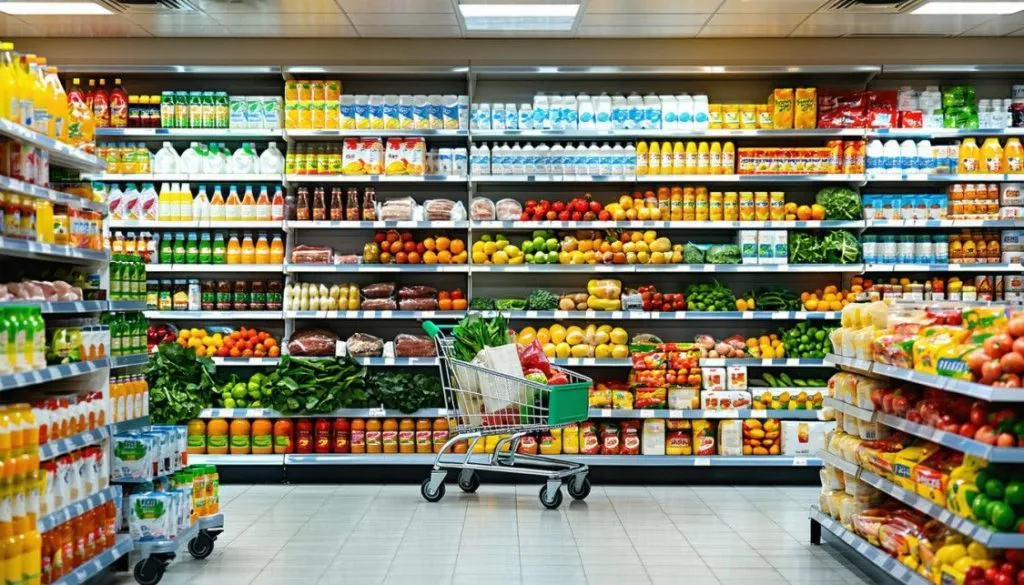
Walk into any Farmatodo drugstore on a weekday afternoon and you’ll see it: people who haven’t necessarily come for medicine. They’ve come to cool down, to stroll, to decompress. In Venezuela’s countryside, when the power goes out, the air conditioning turns the store into a refuge. That might sound like anecdote, but it’s actually market data: the shopping experience matters — and in Venezuela, it matters more than any income survey would suggest.
That is one of the conclusions of a new psychographic study of the Venezuelan consumer, presented on Wednesday, March 28 by economists Asdrúbal Oliveros and Jesús Palacios Chacín, lawyer and consultant Alejandro Guzmán, and BAM Consulting, the marketing firm led by Isabela Hernández. The study, conducted on a nationally representative sample of 1,000 responses, is the most comprehensive of its kind in years. It crosses value systems, purchasing behavior, geography, and generation to map a consumer the crisis transformed — but did not break.
The surveyed universe skews adult: more than 65% of respondents are over 36, placing the older adult population at the core of the active consumer base. In socioeconomic terms —defined by access to services, housing, education, and healthcare— 75% of respondents fall into the Urban Poor (35%), Lower-Middle (25%), and Rural Poor (15%) segments, accurately reflecting the real demographic weight of consumption in the country. Only 25% fall within the Middle and Upper strata.
What the Venezuelan consumer values
When asked what was “very important” to them, the results were both clear and revealing. Having stability and security topped the list at 94.79%, followed by being free and independent (94.69%) and respecting rules and others (93.29%). Self-direction dominates the value spectrum: the Venezuelan, shaped by years of uncertainty, places control over their own life above all else.
At the opposite end, seeking power and influence scored just 28.13% — the lowest reading on the entire scale. The study interprets this not as apathy but as pragmatism: a society that has survived through adaptability and conviction, not through hierarchy.
In other words, the Venezuelan consumer tends to operate within a dimension of adaptability dominated by pragmatism and survival.
The consumer in action: informed but selective
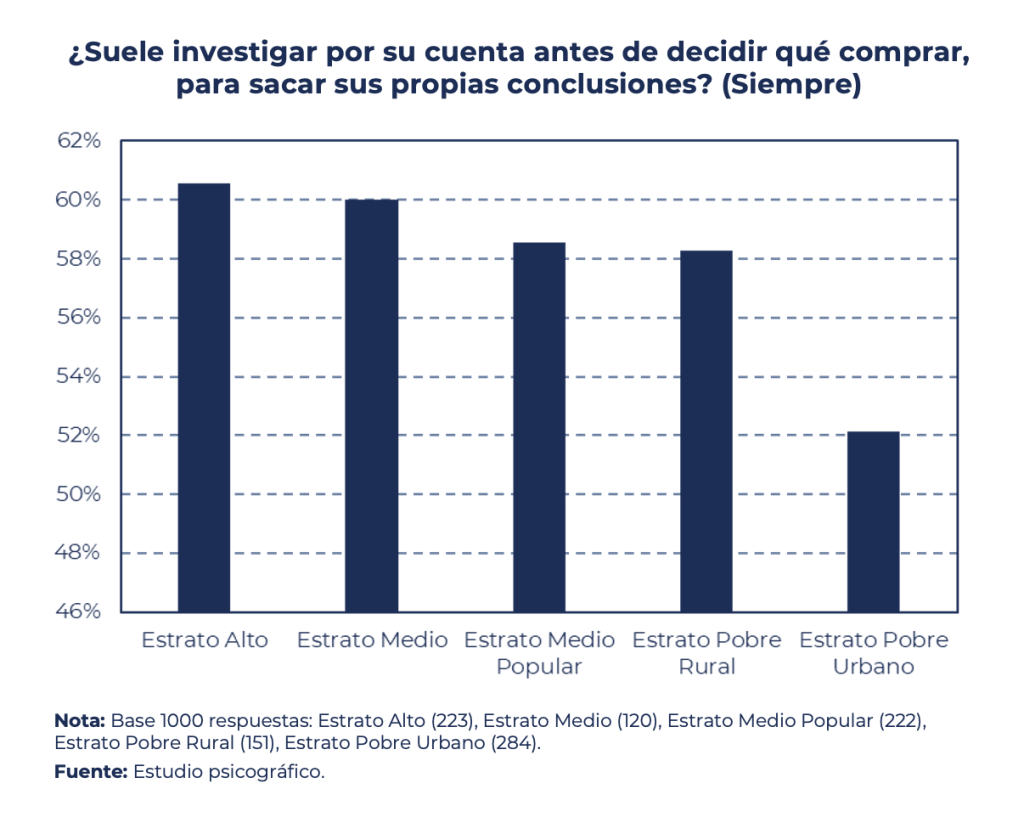
One of the study’s most significant findings is the intellectual autonomy of Venezuelan consumers at the point of decision. A full 57.26% say they always research independently before deciding what to buy, and another 21.42% do so frequently.
In total, around 80% of respondents inform themselves “always” or “frequently” —whether through websites, consulting acquaintances, checking social media, following micro-influencers, or other means— before spending. The only stratum where that percentage drops, and even then stays above 70%, is the Urban Poor. In other words, impulse buying has clearly lost ground.
But that information comes with a constrained budget. The Venezuelan consumer knows what they want — they just can’t always afford it, and that tension generates particular behaviors. In lower-income strata, short-term consumption is more highly valued: the immediate gain outweighs planning. In upper strata, saving and asset protection matter more, and comfort — choosing what feels good even at a higher price point — is the decisive purchase factor.
Comfort, for example, is not a uniformly distributed value: 70% of the upper stratum declares “always” choosing what makes them feel most comfortable when buying, the highest figure across the entire scale. As income falls, that figure drops —the middle stratum registers just 59%— before partially recovering in lower strata, where other factors come into play. The time horizon also shortens with income: the preference for immediate gratification over the better long-term option is most pronounced in the Rural Poor and Urban Poor strata, a rational response to economic uncertainty when the margin for error is minimal.
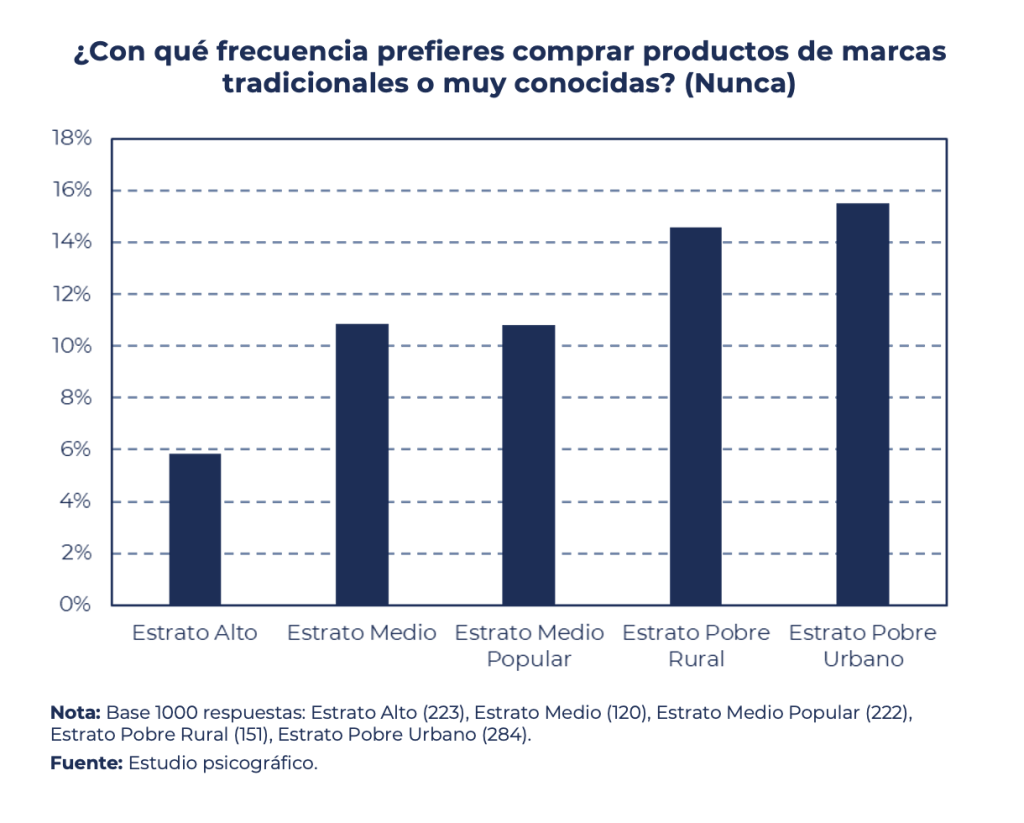
Meanwhile, brand loyalty in Venezuela tracks income: the higher the stratum, the more consistently consumers prefer traditional or well-known brands. The upper stratum leads the “always” category (23%) and “frequently” (33%), while in the Rural Poor and Urban Poor strata the weight of “sometimes” grows (49% and 43%, respectively) — a signal of consumers who don’t abandon trusted brands by conviction, but by budget. In fact, in these strata, up to 15% say they “never” do so. When the money is there, the familiar brand wins. When it isn’t, whatever is available does.
The pursuit of intense emotions through consumption is also more pronounced in lower-income strata. The Urban Poor stratum leads with nearly 30% in the “always” category when seeking products or services that generate different experiences — surpassing the upper stratum, which registers the lowest values.
Likewise, it is the lower strata —Urban Poor (36%) and Lower-Middle (34%)— who most frequently declare “always” choosing products that make them look successful or improve their social standing, above the upper stratum (26%) and middle stratum (23%). Aspiration intensifies where the budget is tightest.
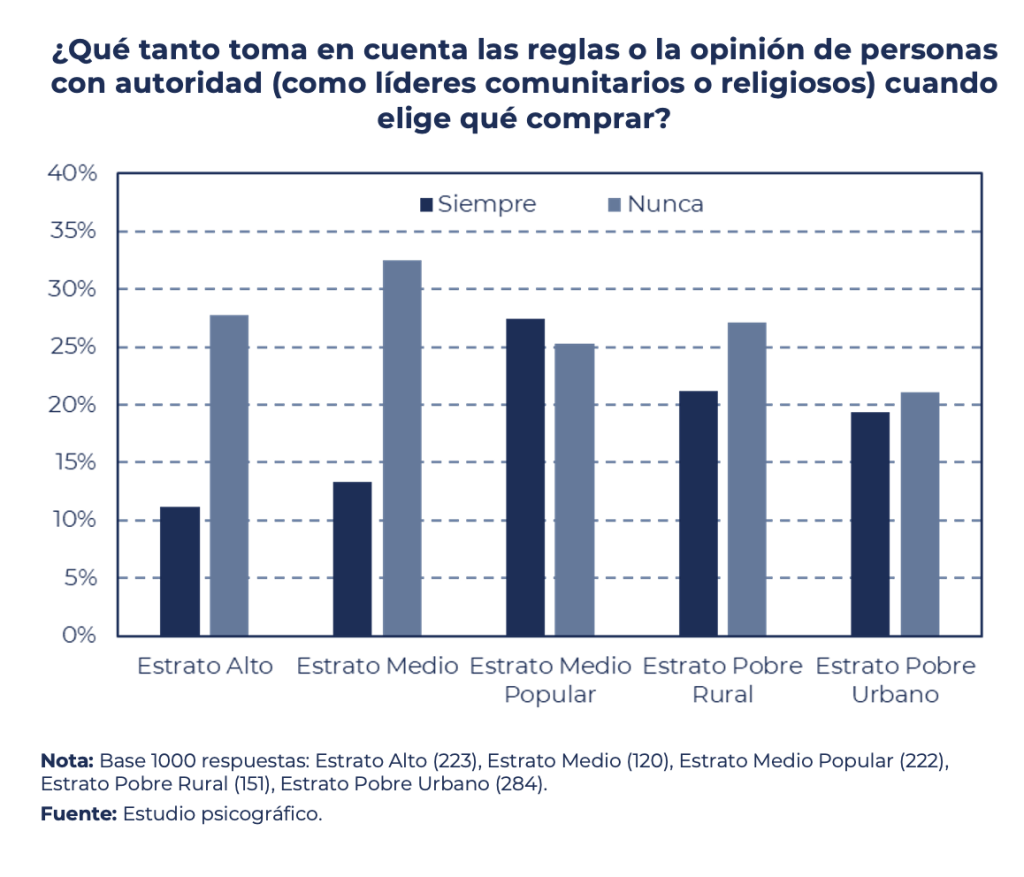
And what about the influence economy? According to the study, the influence of authority figures —such as community or religious leaders— is lowest in the upper tiers: only 11% of the upper stratum and 14% of the middle stratum declare “always” following them, compared to 27% of the Lower-Middle stratum. The higher the income, the greater the decision-making autonomy — and the lower the willingness to be guided by others when spending.
Religion, family, culture, and beauty
Home remains the epicenter of Venezuelan life, and of consumption, though with notable variation by socioeconomic stratum. In lower-income strata, more than 60% of respondents report “always” spending time at home with family. In fact, across all strata, 80% or more report doing so “always” or “frequently.” This is largely explained by the matricentric nature of Venezuelan society, as Oliveros explains — one in which family stability anchors everything else, including consumption.
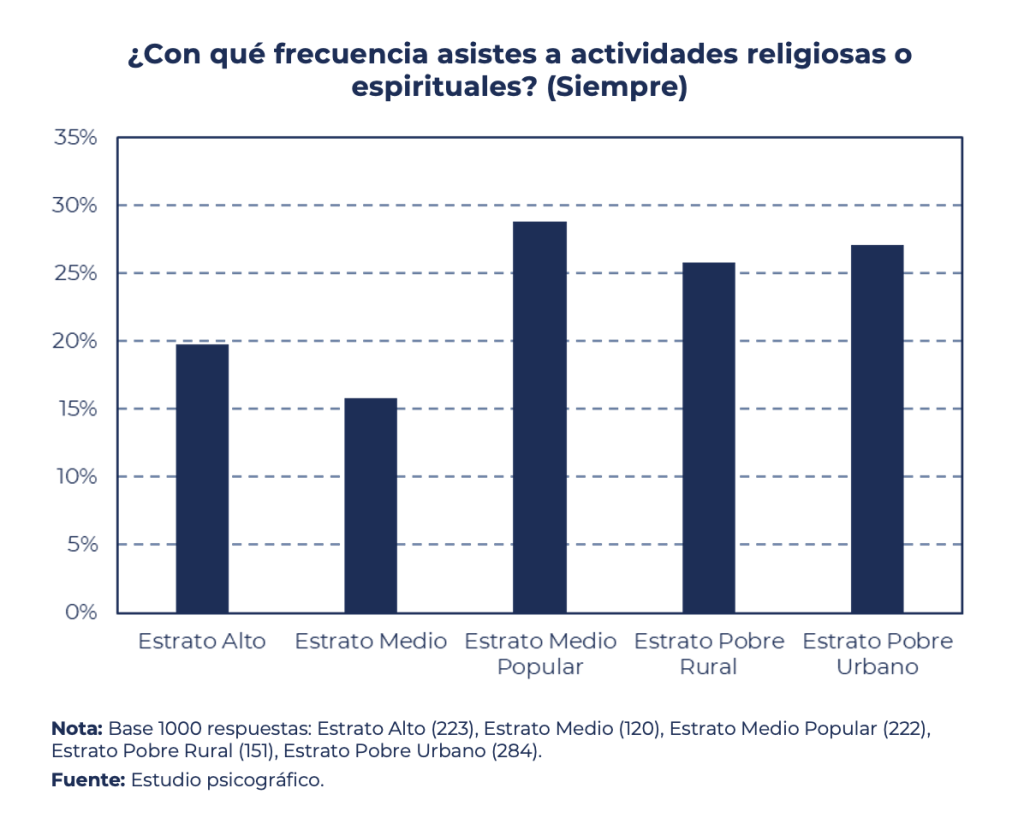
On religiosity —syncretic in Venezuela and increasingly drawn toward spiritual and esoteric practices during times of crisis— the findings are notable: in the Lower-Middle and Urban Poor strata, participation in religious or spiritual activities approaches 30% in the “always” category, above the higher strata, which hover around 20%. Faith —or spirituality broadly defined— remains a resilience mechanism in lower-income communities, but also in middle and upper ones.
Cultural participation (concerts, creative and cultural activities, painting, writing, etc.) is more heterogeneous. The upper stratum leads in frequency of cultural activities, but the gap is less pronounced than one might expect: even in the Urban Poor stratum, only 29% report “never” participating, meaning 71% engage in some form of cultural activity. However, in no stratum does more than 30% do so “always” or “frequently,” revealing the constrained budgets of consumers across the board.
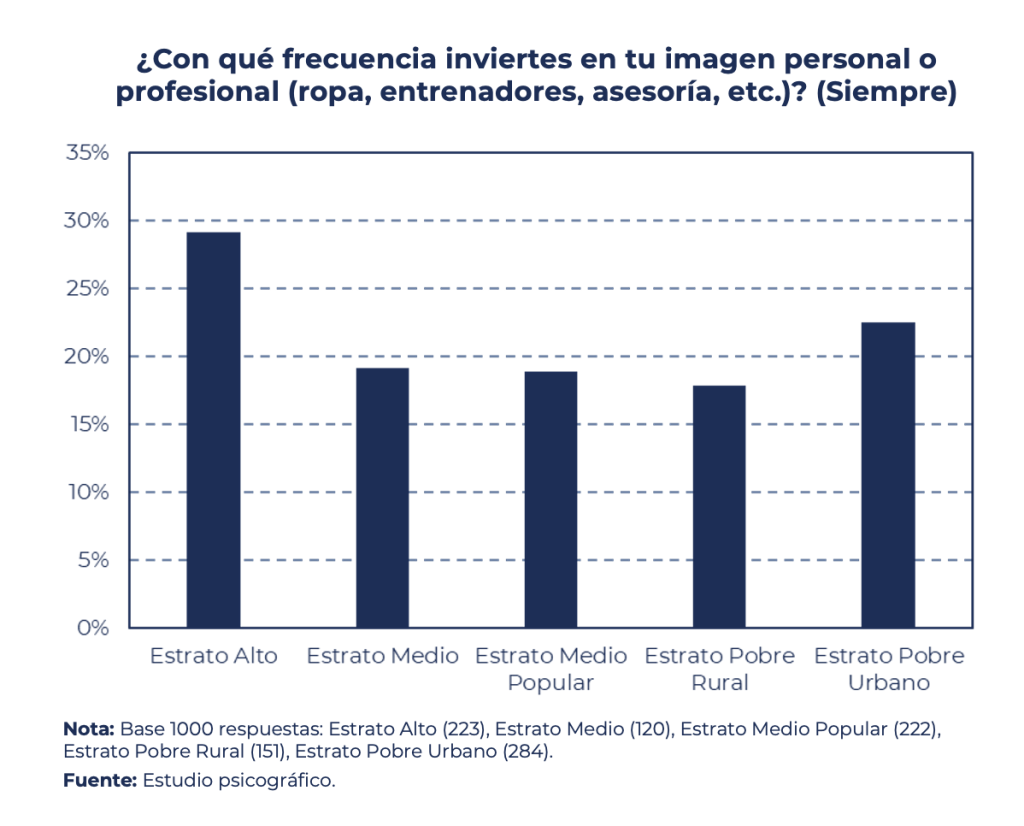
Beauty is a category unto itself. Oliveros was emphatic: people don’t stop spending on beauty. What changes is the brand, not the habit. It’s a form of consumption that outlasts crisis because it fulfills an emotional and social function that transcends the product. Across all strata, around 20% “always” invest in their personal and professional image through clothing, trainers, consultations, and similar services. In the upper stratum, that figure rises to 30%.
The value placed on education also remains one of the most robust and cross-cutting traits of the Venezuelan consumer — regardless of stratum, formation and the willingness to invest in it appear as a central aspiration, one of the few constants the crisis did not erode.
Generational, gender, and geographic divides
The study offers a generational map of consumption that breaks with conventional frameworks. Venezuelans aged 54 to 73 orient toward conservation and self-transcendence — concerned with others and with legacy. Those aged 42 to 53 share that concern for the broader environment but show a stronger tendency to seek external validation before purchasing: being “Anti-Never” when it comes to consulting others is one of their defining traits. Young adults aged 29 to 41, in contrast, prioritize self-promotion, while younger consumers aged 18 to 28 are defined by openness to change and trust in digital institutions and online influence networks — though, even when it comes to considering environmental preservation in consumption, a point where this generation scores surprisingly low according to the survey, they don’t prioritize self-transcendence.
Gender differences are also measurable. Women over-indexed in response intensity throughout the study: men tended to be less expressive, more frequently choosing intermediate options. Hernández flagged this as a methodologically relevant finding — Venezuelan women are more categorical in their values and preferences.
Geographically, the study reveals distinct value orientations around consumption. Zulia leans toward the conservation of its society and values; Carabobo toward openness to change; and Caracas distributes diffusely across multiple orientations. Táchira emerges as a singular case: its economy, largely dollarized in Colombian pesos, makes it function almost as an extension of the Colombian market. The study also identifies high commercial opportunity zones —the Eastern region, Bolívar, Barinas, Táchira, Zulia, and Falcón— where economic activity is showing growing dynamism.
What’s coming: the returning Venezuelan consumer
Oliveros, the economist, provided the macroeconomic context. According to data from his team, approximately 2.5 million Venezuelans will move up from the poorest strata in the coming year. Added to this is the 11% of the diaspora —some 800,000 people— who plan to return to the country in the near term according to the NGO Venezuelan Diaspora Observatory, generating a pool of 3.3 million new consumers.
Oliveros’s conclusion points to something the data supports: Venezuela’s appetite for comfort did not disappear with the crisis. It was suppressed. “What will return when purchasing power recovers is already in the Venezuelan DNA,” he said. Pre-crisis studies documented, for example, that Venezuelans rejected walking and preferred to buy everything in one place. Today, they prefer to browse multiple outlets out of price sensitivity. For this reason, brands that understand that this Venezuelan consumer already researches, already discerns, and already decides —even on a constrained budget— will be best positioned to capitalize on the recovery of income and, with it, comfort as a guiding compass.
Oliveros’s final recommendations are precise: companies must design value propositions that reduce perceived risk — not just sell attributes, but certainty of functionality and reliability. Pricing must function as a strategic tool, not a static exercise, in an impoverished market where pricing errors can exclude large segments. And segmenting by income alone is no longer sufficient: in this Venezuela, the average Venezuelan consumer is informed, selectively values experience and wellbeing, and operates on a constrained budget. Take note.