




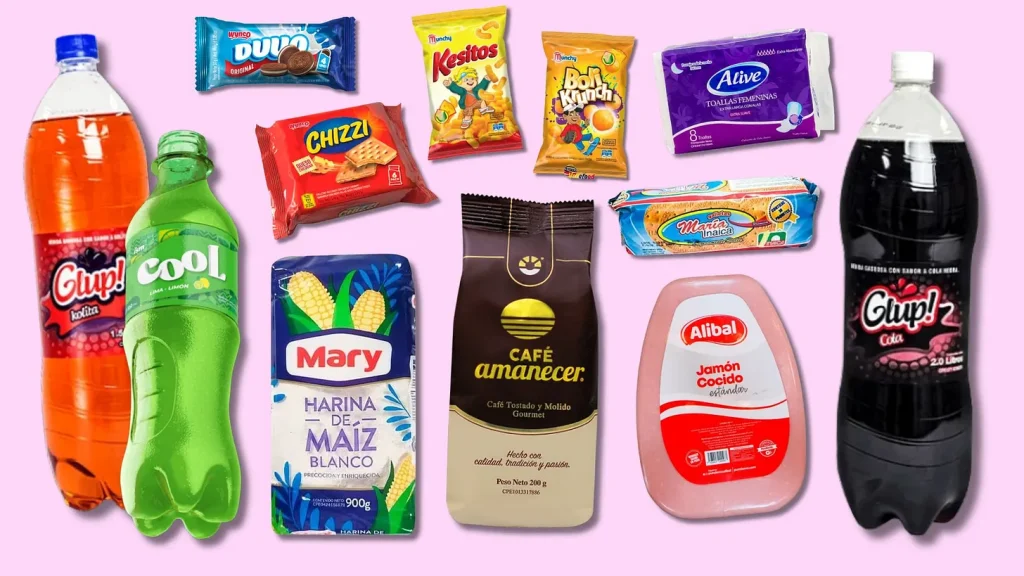
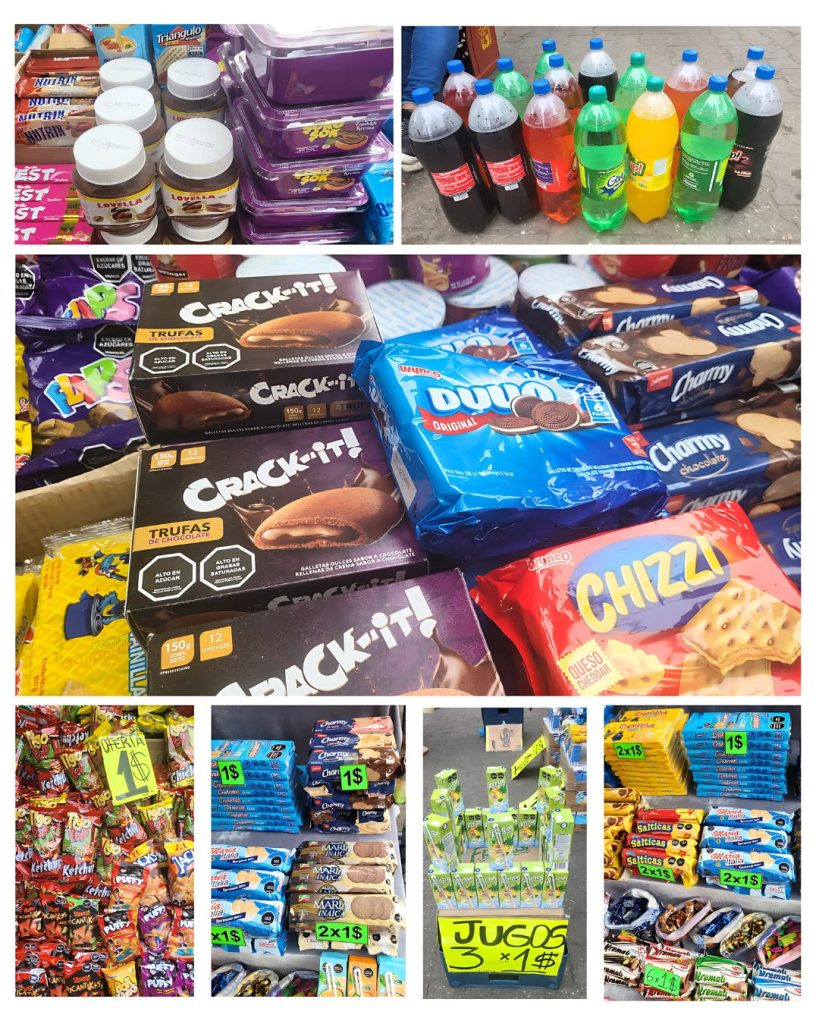
“Duuo cookies are gone,” says a street vendor, referring to a brand of cookies similar to Oreo, “They sell out really fast.” Like Duuo cookies, which imitate the shape, or Porleo cookies, which mimic the Oreo logo and name, on Catia Boulevard—that bustling artery packed with street vendors, clothing and candy vendors, from the La Silsa neighborhood to Plaza Sucre—street vendors offer “their first cousins” or “the lookalikes”: many imported from Colombia or Turkey, emulating the most recognized brands that usually populate the shelves of a Farmatodo drugstore or an Excelsior Gama supermarket.
María Italia or María Inaica replace the María de Puig cookie. Charmy appears as a more affordable version of the Marilú. Chizzi, even in appearance, is equivalent to Ritz. Lovella, Nutella’s Turkish cousin, is sold alongside the Turkish Tam Çikolatam biscuits. Outside the Farmatodo in Catia, where Grisbi cookies are sold, an equivalent called Crack-It! appears, and 77 Italiano emerges as the bastard child between KitKat and Sorbeticos. Saltitacos rival Club Social, Fruttsi juices replace Yukery, and Glup! and Cool soft drinks almost completely displace Pepsi and Hit. It’s no small feat: both in the last months of 2022 and in the last months of 2023, the Glup! brand –which appeared in the early 2010s– surpassed Pepsi in market share among soft drinks by as much as six points in the modern supermarket channel (Coca-Cola has remained above the competition) according to data from the market research firm Nielsen. In the traditional channel—the network of small businesses such as grocery stores, bodegas, kiosks, and informal retailers, which operate directly with consumers, outside of large supermarket and pharmacy chains— Glup!’s market share could be even higher.
To a large extent, the success of new brands—in an impoverished country—is due to price: While a Grisbi at Farmatodo costs 480 bolivars, a Crack-It! sells for 120 bolivars. In fact, along the boulevard, “first cousin” brands are sold in two-for-a-dollar promotions. A street vendor, for example, sells Jack’s pork rinds for 430 bolivars (about four dollars). But new brands, such as the Turkish Tigo Pop or Puffy or Boli Krunchy from the emerging Venezuelan group Munchy, entice with their “two-for-a-dollar” deals. It goes without saying that, in this context, many imported brands—even some that enter illegally or through contraband—manage to position themselves better than domestic brands, whose cost structures, hit by the complex Venezuelan environment, make them less competitive on price. In fact, the National Soft Drinks Association reported that more than 40% of the soft drinks consumed in Zulia were smuggled from Colombia.
“There is a configuration of brands, products, and categories toward a population that is predominantly poor” after a long and profound economic crisis that included the disappearance of almost 80% of GDP, acute shortages of medicines and food, and a spiral of hyperinflation over a period of several years, says Asdrúbal Oliveros, managing partner of the research and consulting firm Ecoanalítica. But “the poor also consume and spend and buy, they just do it differently,” says Oliveros. As brands understand—or have managed to understand—how this new consumption dynamic works, new products, categories, and strategies focused specifically on this consumer segment have begun to emerge, he explains.
In fact, the structural consequences of the crisis also changed the behavior of the average Venezuelan consumer. “They were very unique consumers in Latin America; with higher income levels than the rest of the continent, very sophisticated, they highly valued quality, comfort, and service,” explains Oliveros, “and they were very brand-conscious.” But the subsequent impoverishment has meant that Venezuelan consumers, while still valuing quality, have abandoned their emphasis on comfort and experience in favor of affordable prices. “Today we have a consumer who is less loyal to brands,” says the economist. “I call them a ‘cheater’ consumer, a ‘polyamorous’ consumer, because they are a consumer who, having budget constraints, looks for alternatives to stretch their money if their favorite brands become too expensive.”
The discovery by these impoverished consumers of similar quality but cheaper products “has meant an opportunity for new players, new brands, that have built an attractive price-quality proposition and have therefore taken over the market,” says Oliveros. In fact, according to a Nielsen survey, 52% of buyers of typical brands will not buy that brand again next year.
But customer “infidelity,” while it has been an opportunity for emerging players, has also been “a headache for traditional players,” explains the economist. For Oliveros, starting in 2020, many Venezuelan companies and brands found themselves failing to understand the new consumer. The landscape and competition had changed. “The power of iconic brands in each category is still present, but it is not eternal,” says Pedro Quintana, managing partner of Atenas Grupo Consultor, a Venezuelan market research firm. “Emerging brands know this and are competing in that arena as well.”
In fact, price prioritization has led Coca-Cola and Pepsi to cut their prices by almost 20% between the end of 2023 and the beginning of 2025, according to Nielsen data, in a successful bid to regain ground against the emerging Glup!. In other sectors, however, relatively new brands dominate: in the coffee market —where there are currently around 125 brands and where the historic giants Fama de América and Café Madrid, which cornered more than 80% of the market, practically disappeared after being expropriated or intervened some 15 years ago— eight of the 10 brands that concentrate 80% of the market, including Amanecer and Flor de Arauca according to Nielsen figures, did not exist before 2000. In sausages, 18 brands —some traditional, others recent; all covering Caracas with fences of hams—share 80% of a highly fragmented market, also according to Nielsen.
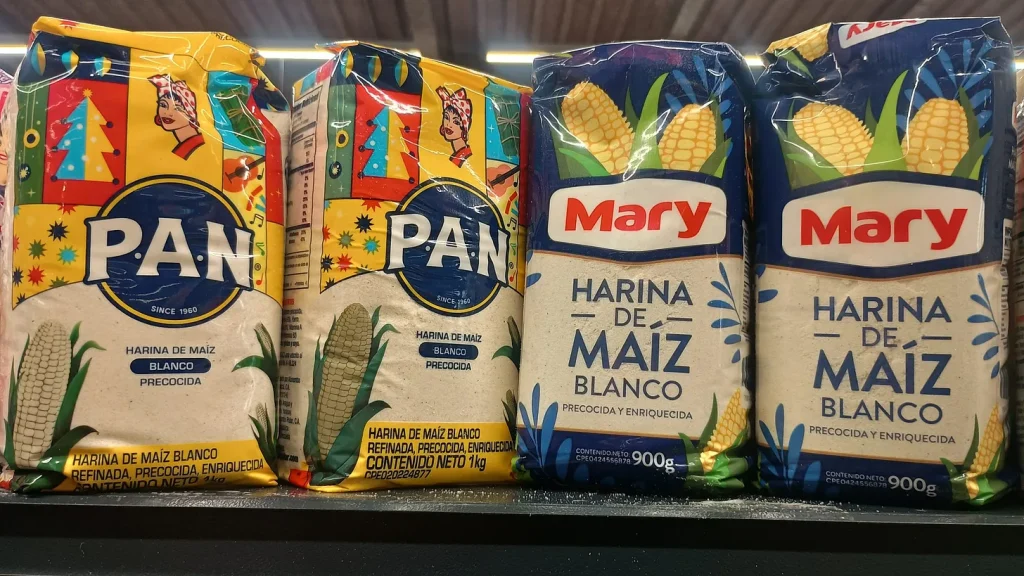
In this new ecosystem, “actors [other than the traditional ones] have emerged that better understand this dynamic [of the new consumer] and have adapted, worked, and have been more aggressive,” explains Oliveros. Furthermore, price competition has also led to a reconfiguration of product presentations that—as brands like Heinz and Mimesa have done —can now offer smaller quantities of liters or kilos at more affordable prices than traditional players. Mary’s new precooked corn flour, for example, is usually sold cheaper than Empresas Polar’s Harina PAN, but it offers 900 grams instead of the full kilo of PAN, something that Polar has sought to indirectly emphasize in its supermarket advertisements.
According to Oliveros, many of these brands have even sought alternative distribution channels to traditional ones, for example, by partnering with popular areas or informal sales networks. Glup!, for example, has grown through a distribution structure linked to warehouses owned by Chinese merchants in the interior of the country, thus taking advantage of differentiated pricing schemes —that is, offering products at lower prices in these outlets than in large supermarkets in major cities, adapting to the lower purchasing power of these consumers. Alive, a personal care brand, has also experienced notable growth in popular sectors through similar distribution channels.
In fact, by the first quarter of 2025, 61% of household purchases in Venezuela were made through traditional channels, which offer “a more varied portfolio of brands and presentations” despite the services associated with modern supermarket channels, Quintana explains. Given this universe of small grocery stores and grocery stores, the Suplymos platform has emerged to facilitate wholesale purchases of mass consumption products for small merchants, warehouses, and businesses—largely in popular sectors—through digital orders and direct deliveries.
The company, in fact, has more than a thousand clients in Petare: “It’s a very diverse universe of customers,” says Ricardo Álamo, co-founder and executive director of Suplymos. While formally billed stores operate in the Petare roundabout, Álamo explains, stores in the higher-income and poorer areas of the neighborhood sell so-called “teticas”: small 100- or 200-gram bags, informally repackaged by the vendors themselves “by eye to the nearest percent,” in their words, to accommodate the limited purchasing power of buyers. “Give me a dollar in sugar,” the customer asks, and receives the “tetica” with the equivalent amount of sugar according to the vendor.
“As long as you understand it, a whole range of opportunities opens up, because this is a market that currently consists of 13 or 14 million people,” says Oliveros, many of whom have also benefited from new sources of income like remittances, “so this market is no small feat.” Besides, although its profitability is not high and involves significant logistical and operational challenges, it has a high turnover rate. Understanding the new consumer “is a process that is still ongoing,” says Oliveros, “in their habits, in their way, in what they want, in how they want it. This market is the great challenge today.”
This story was supported by the fieldwork of Raúl A. Castillo.