






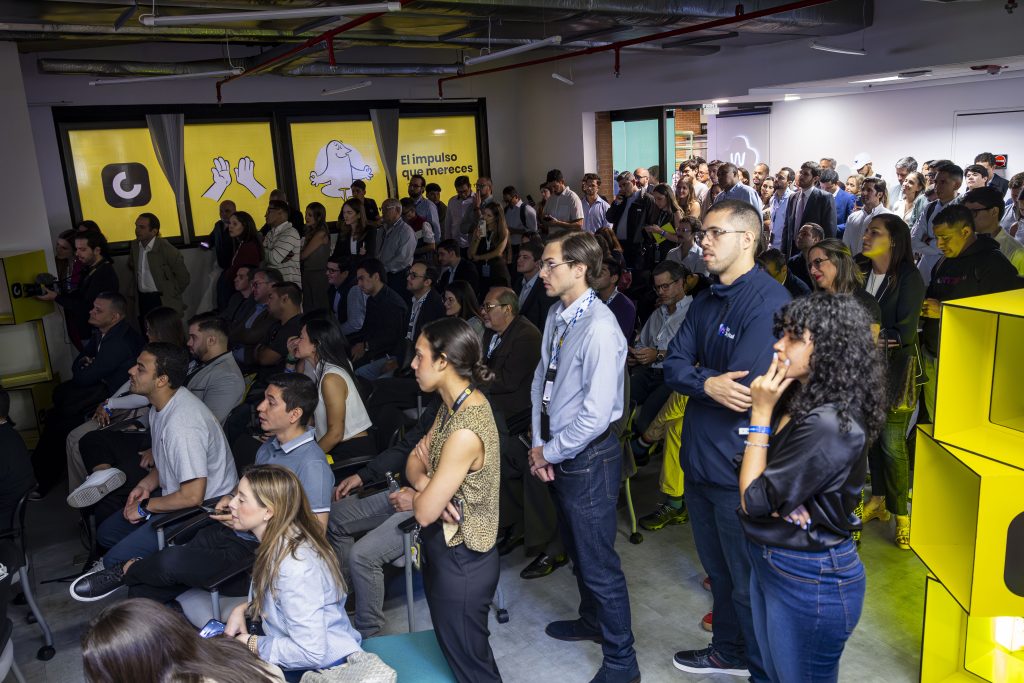
Beyond its hundreds of attendees and 60 panelists, the Startup Venezuela Summit 2025 made it clear that the Venezuelan entrepreneurial ecosystem is undergoing a stage of maturation. Held in October at the Caracas Campus complex in the southeastern neighborhood of La Trinidad, the Summit’s discussions focused not only on ideas and inspiration, but also on execution, adaptation to the Venezuelan context, and strategic decision-making in a complex yet opportunity-filled environment.
From artificial intelligence and applied technology to financing, talent, and scalability, the presentations and panels reflected a common narrative: Venezuela is no longer discussed solely as a “difficult” country, but as an underserved market where those who understand its rules can build real advantages. Several key points emerged from these conversations, summarizing the current state of the ecosystem.
Here are six takeaways from the Startup Venezuela Summit 2025:
1) Yummy was the Petri dish of the Venezuelan tech ecosystem
Delivery and mobility platform Yummy was born from the understanding that “the idea is the easy part; the hard part is adapting it to the local context,” explains Ignacio Carrillo-Batalla, the company’s Chief Technology Officer. From the outset, its founders assumed that proven models from abroad —delivery, ride-hailing, and e-commerce— could only work in Venezuela if they were rewritten for a country with fragmented payment methods, high operational friction, and its own unique rules. “Adaptation was key. You couldn’t just copy and paste a model from abroad without understanding how Venezuela operates,” says Alejandro Sierra, co-founder of Yummy. “This is a blank canvas. There’s little competition and a lot to be done, especially outside of Caracas.”
That logic turned Yummy into a permanent laboratory. “We had to dedicate an entire team just to payment methods,” explains Carrillo-Batalla, a decision that reflects how adaptation became a competitive advantage. “Where you see an unnecessarily complicated process, there’s probably an opportunity,” says Sebastián Acosta, product lead.
This role as an ecosystem laboratory is also reflected in its growth strategy: Yummy acquired Wink, a Venezuelan e-commerce startup, integrating its team and technology into the platform; as Acosta summarizes: “Wink is basically a tropicalized Shopify, adapted to the needs of the Venezuelan market.” For Sierra, “adapting transactions to the local market was one of the biggest challenges and one of the things that worked in our favor.
Over time, the company has begun to cultivate tech talent in an ecosystem where it was almost nonexistent. This multiplier effect is what ultimately defines Yummy as a Petri dish of the Venezuelan ecosystem: “Yummy became a kind of tech university,” says Carrillo-Batalla, “Many people who came through here have now joined the development teams of other companies or are starting new ones.”
2) Digitel is adopting artificial intelligence as a long-term strategic process

For telecommunications carrier Digitel, the adoption of artificial intelligence is not a sprint, but rather “a marathon.” This is how Gabriel J. Díaz Campion, the company’s Chief Information Officer, explains it, emphasizing that AI at the operator arrives as part of a broader technological modernization process, anchored in the business strategy and data governance.
After years of divestment, Digitel prioritized modernizing its network and core systems before moving into digital ecosystems. With the increase in traffic and data, the company had to organize its information sources and establish governance frameworks so that artificial intelligence could fit coherently within the organization. The first concrete application was in cybersecurity, with supervised machine learning models to protect customer data.
The evolution continued with Digitel’s app, which incorporates artificial intelligence and advanced image recognition components, aiming to make it the primary customer service channel. “Now we are embarking on a new path with natural language processing. When a customer contacts Digitel, they will be assisted by a system that understands intentions, using natural language processing and unsupervised machine learning,” says Campion, in a context marked by the rollout of 5G and the growth in data volume.
In parallel, the company is promoting cross-functional training, upskilling, and reskilling programs partnerships with universities, and investments in technologies such as cloud computing, no-code to develop MVPs faster, and sustainability. “With so much digital modernization, a lot of hardware became obsolete, and we are reducing our carbon footprint,” he says. “We are looking for highly specialized data scientists to enhance our data capabilities and we work with universities on entry-level programs, incorporating artificial intelligence skills with a distinct abstract and cognitive reasoning approach.”
“Ultimately, what we want in Digital is to translate feelings into digital form, to understand intentions and mindsets,” he explains. “The big challenge is how to modernize systems, how to evolve digital channels, and how, through innovation and design thinking, to understand user perspectives and translate them into technology. Our AI adoption plan has early wins, but it’s designed for three years: it’s not a plan for speed, it’s a gradual plan.”
3) Mastercard is building the digital commerce highway of the future in Venezuela
In Venezuela, Mastercard’s journey has accelerated in the last two years with the migration of Maestro brand debit cards to Mastercard debit cards, a key step in enabling contactless payments and card use on digital platforms. Claudia Acosta, country manager for Venezuela, explains that the company’s strategy combines decades of evolution in payments with artificial intelligence, data, and global standards to sustain the growth of digital commerce. “We needed to migrate the cards to be able to develop all the payment applications,” explains Acosta, emphasizing that it’s not just about the physical card, but a new messaging highway upon which more advanced products are built.
This infrastructure separates two worlds of payment. In the physical world, payment is made with a card at the point of sale: the card is held near the reader, inserted, the chip is used, and in some cases, the PIN is entered. In the digital world, however, less visible concepts come into play for the user.
Tokenization means that the actual card number doesn’t travel over the internet when you pay online: it’s replaced by a unique, much more secure digital code that protects the purchase and reduces fraud. Passkeys,meanwhile, are a verification method that replaces over-the-top (OTP) codes: instead of typing numbers, the user authenticates with their fingerprint, face, or phone lock screen. “The goal of the entire digital world is to make it frictionless,” Acosta points out.
Building on this foundation, the next leap emerges: agentic commerce. Today, nearly 20% of global e-commerce purchases are already executed by artificial intelligence agents. The challenge, Acosta explains, is ensuring these transactions don’t occur “in the dark.” With Mastercard Agent Pay, the company aims to verify agents, tokenize each payment, and authenticate every step, guaranteeing clarity regarding the user’s intent and consent. “Consumption, intent, and consent captured and verified,” she says. For Mastercard, this represents the next frontier of commerce: payments that operate at the speed of life, built on trust, visibility, and scale.
4) Due to its unique characteristics, Venezuela has many markets yet to be exploited

Venezuela is a market brimming with untapped opportunities. That’s what Patrick Dolman, an investor who previously worked at Bicycle Capital and Morgan Stanley, argued on a panel with young entrepreneurs. “Every time I come to Venezuela, I get excited. I started coming back last year because I saw so many opportunities. We invested in a motorcycle company in Brazil, where they sell 3 million motorcycles a year with a population of 220 million,” he said, “In Venezuela, 700,000 motorcycles are sold per year with a population of just under 30 million. That ratio is unbelievable. It’s a very consumer-driven market and it’s open to anything.”
Dolman illustrates it this way: when you launch software, there’s a real willingness to pay; in the case of the deferred payment platform Cashea, moreover, people actually follow through and pay back. That consumption drive and openness to new ideas, he says, isn’t something that happens in a “normal” country. And it’s precisely this anomaly that excites him: looking at what’s happening and realizing it’s an enormous opportunity.
5) Verónica Ruiz del Vizo and the Andrés Bello Catholic University hope to train 25,000 Venezuelan educators in AI
The adoption of AI is not uniform and must be based on the specific needs of each sector. Marketing guru Verónica Ruiz del Vizo put it this way: “The question is, where does my business begin integrating artificial intelligence? Your business is agriculture, another’s retail, another’s finance: we don’t need the same tools, nor do we have the same problems,” she said. “Understanding that, and trying to avoid falling behind, the question is, where do we begin?”
Ruiz del Vizo explained that this approach has led her to promote an ambitious artificial intelligence training program in the region. The project aims to train one million people, 25,000 of whom would be in Venezuela, and has already taken its first step with the signing of an agreement with the Andrés Bello Catholic University to train educators. The goal, she noted, is to integrate AI into primary and secondary education so that students begin using these tools even before many teachers fully master their operation.
6) Venezuela is an underserved market with many hidden competitive advantages
For decades, Venezuela has been perceived in the corporate world as uncharted territory, almost impractical for investment. However, for a growing group of technology and service companies, this narrative has obscured structural competitive advantages: market size, high digital adoption, low international competition, adaptable talent, and still unmet demand. “Abroad, people seeing the scene might think it’s artificial intelligence,” says Carlos Navarro, partner at investing firm VIP Capital, “but this is actually happening here.”
For some multinationals, entering Venezuela wasn’t a rash act of audacity, but a strategic decision based on variables that others chose to ignore. “We entered when many saw only risks,” recalled Andoni Alava, managing director of the delivery platformPedidosYa in Venezuela. The initial assessment combined market size, demographics, technological adoption, and a comparative analysis with other countries where they already operated. “Venezuela is a large country, with a GDP far exceeding that of Central American countries where we have successful operations,” Alava said.
Convincing the parent companies wasn’t easy. Alava explained that the process required translating the Venezuelan opportunity into corporate language. The decision was based on numbers, but also on context: low international competition, very high smartphone penetration, and still underserved demand. “When we entered the market, there wasn’t much competition, and the usability conditions were already there,” he added.
From the perspective of other technology companies, the attractiveness of the Venezuelan market lies in its “blue ocean” nature—a market where a company can create new demand in the face of little to no competition, allowing for growth—said María E. Pereda, country manager for Venezuela at the mobility platform Yango. According to Pereda, the low level of digitization of everyday services creates space for growth without displacing existing players: “The penetration of non-digital mobility services remains enormous.”
These factors are complemented by a long-term structural advantage. María Eugenia Salazar, a partner at the law firm Baker McKenzie, pointed to the country’s energy potential. “Not a single molecule of natural gas has been extracted here, and our neighbors don’t have gas,” she said, defining Venezuela as a latent energy powerhouse. In her view, multiple goods and services industries, yet to be built, can be developed around this foundation.
Venezuelan talent is also a “fundamental” asset for companies that decide to enter the country. “Without a local team that understands the market and can move at the speed the company wants, it will be very difficult” to prosper, Alava said. Similarly, Pereda agreed, highlighting “agility” as a key competitive advantage: “What we have experienced over the last thirty years has forced us to respond quickly, think outside the box, and have innovative ideas.”
Beyond the regulatory framework and the numbers, the emotional factor also plays a role in decision-making. “You can’t convince a multinational with emotion alone, but neither can you convince it with numbers alone,” explains Alava. In his experience, perceptions change when decision-makers visit the country. “When they come to Caracas, see the infrastructure, and understand Venezuelans, their minds open: there’s an opportunity here.”
This shift in perspective is repeated among those visiting the country for the first time. “The most common comment is: ‘Why didn’t we come here sooner?’” said Pereda, recounting the experience of receiving international delegations. “And the truth is, this is something you only experience when you come to Venezuela, when you understand that there are still 20 million people who move around every day, who go to work every day, who use public transportation every day, or who have to ask for food every day.”
Pereda also downplayed the idea that Venezuela is an exceptionally complex case, stressing that Yango even operates in emerging markets where it employs a workforce with high levels of illiteracy: “We often think that Venezuela is a very particular case,” she said, “but there are first-world technology companies operating in much more complex markets, in Africa or the Middle East.”
The presence of multinational corporations, far from displacing local entrepreneurship, can raise market standards. “We are going to convince multinationals to come here,” said Alava, “not to take away the space from entrepreneurs, but to compete, raise the bar, and make things better.”
Thus, for Navarro, all these processes are shaping a new business ecosystem: “The Venezuelan business network is being filled with people who, under the premise of know-how and not know-who, are making things happen.”