


María Elena Pombo (Caracas, 1989) has developed a body of work that transforms avocado seeds, petroleum, algae blooms from Lake Maracaibo, and other materials into threads, sculptures, and installations that question the relationship between territory, memory, and extractivism. Her work questions the export-driven dependence and rent-seeking of a volatile raw material, highlighting the impact of extractivism on Venezuela’s lands and waters, from the sand of Canaima to the algae that pollutes the lake. Pombo rethinks our way of consuming and of being as Venezuelans, even from her family background in the oil industry in Cabimas, by almost sardonically exchanging oil for avocado seeds that are transformed into pink ink, bricks, or fuel, or producing fabrics from the same crude oil or toxic algae bloom: weaving them, like the fabric of a country, rather than sowing it – as Venezuelan 20th century intellectual elites insisted.
Pombo, a Venezuelan artist and researcher based in New York whose practice straddles material experimentation and reflection on the diaspora, graduated as an industrial engineer at Simón Bolívar University in Caracas and later in fashion design at Parsons School of Design in New York City. Today, her work is part of the permanent collection of the Art Institute of Chicago—which recently acquired eight pieces from the “La Rentrada” series—and has been exhibited at venues such as Somerset House in London, the Bronx Museum of the Arts in New York, Mana Contemporary in Jersey City, Yamamoto-Seika in Osaka, Fabbrica del Vapore in Milan, and the Zona Maco fair in Mexico City. Recognized with the Theme Medal at the 2021 London Design Biennale, Pombo has consolidated a visual language that combines scientific rigor and poetic sensibility, positioning natural dye—particularly the pink she extracts from avocado pits—as a vehicle for nostalgia, diaspora, and the transformation of the economic backbone of Venezuelan identity.
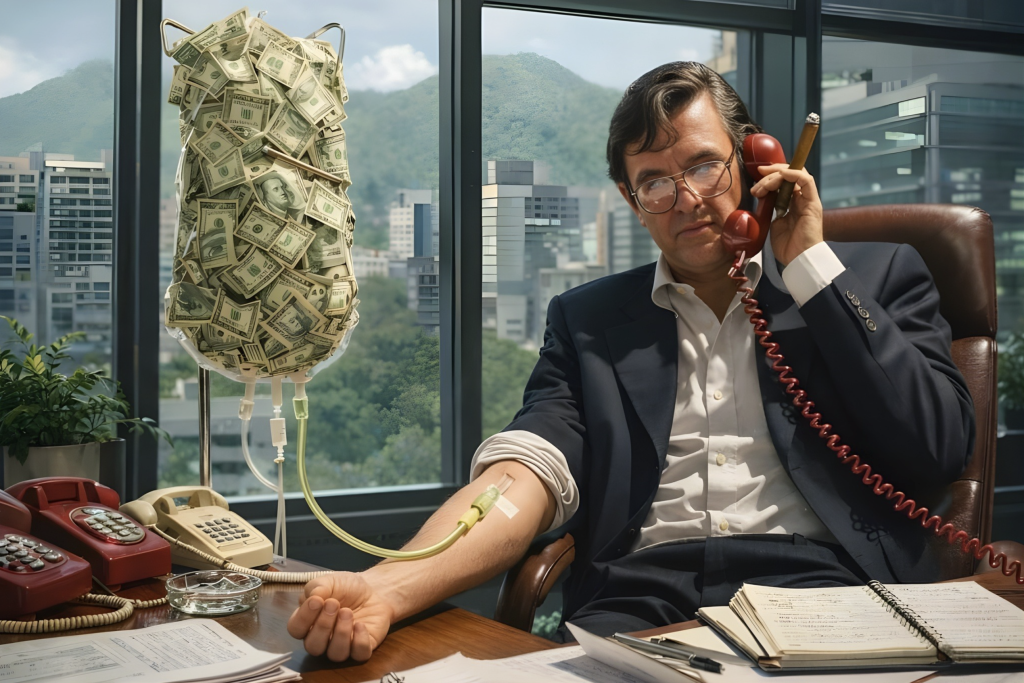
You represented Venezuela at the London Design Biennial and won the Theme Medal with “La Rentrada,” a pavilion that imagined circular economies based on the avocado seed: from dyes and bioplastics to brick prototypes, even functional gasoline, and the provocative idea of an OPEC of non-avocado-exporting countries. All of this was based on a scenario of massive return of the Venezuelan diaspora. Within this framework, through your work, how do you address or rethink today the logic of rentism and the mono-export economy in Venezuela, as well as the extractivist dynamics and their cycles of boom and bust—which not only mark Venezuelan oil history but also the violent avocado industry in Mexico? How does the “reentry” of the diaspora fit into this reconsolidation of an oil-based, black Venezuela into an avocado-producing, pink Venezuela?

The way I defined ‘La Rentrada’ (The Reentry) is as a project that imagines the return of the Venezuelan diaspora, understanding that it will be marked by a radical questioning of previous systems. However, the project makes it clear that this reentry is one of many, inviting everyone to imagine their own return.
In my case, the reentry I proposed, as a kind of provocation, is an economy centered around the avocado seed. An economy of transformation, not extraction. Value isn’t provided by the avocado itself, but by the seed itself. From this comes the idea of the Organization of Non-Avocado Exporting Countries, made up of the “losing” countries in avocado exports. Large producers that don’t export or export very little compared to their production. The idea isn’t to compete with Mexico and Chile in avocado exports, but to create a system completely different from the extractivist and mono-export logic. To break with this idea of participating in primary and secondary economies. A bit like my interpretation of Gerver Torres’s dream for Venezuela.

Upon your return to Venezuela after eight years away, you presented “Tejiendo la Anemoia,” a textile installation that transforms materials and waters from the region into threads/fabrics to speak of memory and belonging. What changed in your relationship with the landscape and memories upon your physical return—and how is this “change of perspective” evident in the piece?
‘Weaving Anemoia’ is a sister project to another called ‘Weaving Morriña’. Morriña is a Galician concept that encapsulates nostalgia for one’s territory. My paternal grandparents are Galician, and I grew up with that concept manifested. Then I experienced it myself. Anemoia is a neologism that encapsulates nostalgia for a place or time you haven’t experienced.
In ‘Weaving Morriña,’ I transform soil from Ávila, water from the Caribbean, sand from the Coro Dunes, and salt from Las Cumaraguas into threads that I then weave into sculptures. In ‘Weaving Anemoia,’ I do the same process with water from Angel Falls, water from Canaima Lagoon, and Canaima sandstone (eroded Auyán tepui).
Ávila, the Caribbean, etc., are places that were part of my life in Venezuela before I left in 2011. Canaima, on the other hand, is a place I visited for the first time in 2023, on a trip I made to Venezuela after eight years of not being there. However, the Auyán Tepui, Angel Falls, etc. were part of my imagination of Venezuela.
In both series, I rethink the idea of landscape. I don’t seek to replicate it, but rather to replicate the experience of exploring these landscapes. In the final result, as pieces that create an atmosphere. And in the process, which is very physical. I make threads with an algae-based gel mixed with soil, water, salt, etc., from specific locations in Venezuela, which I then extrude into a solution that cures it. It’s a very dense solution that requires a lot of force on my part to extrude. Then, I also weave by replicating the way we move in these spaces. ‘Weaving the Canaima Lagoon’ I wove in a horizontal pattern, just as you move through it. ‘Weaving Angel Falls’ I wove in a vertical pattern, since that’s the way it presents itself to us.
I’ve always had a great admiration for Venezuela’s landscapes. I vividly remember the first time I saw Las Cumaraguas and Playa Colorada, when I was a child, for example. Living outside of Venezuela has only intensified this.
Your material research with avocado peels and seeds creates a “pink” color that depends on tannins, pH, and water hardness; it’s art, but also an environmental fact. How did you transform this chemical fragility into your own aesthetic language?

My path to becoming an artist began with research into natural dyes and earth materials. I don’t have a background in the arts. For a time, I saw this as a disadvantage, but I think this strange path actually helped me develop my own aesthetic language based on process and materials.
I work on projects and always start with a specific territory and/or material. I never know 100% how the artworks will turn out. I can replicate my seaweed-based yarn recipes, for example, but if the environment where I make them is drier, they’ll have a different shape than if I made them in a humid environment. The process of producing work is always an adventure. A very stressful adventure that demands a lot of confidence in myself and in those who want to exhibit my work because it requires a great deal of trust on their part.
In “Rosa Terraqueo,” a series you’ve exhibited in Osaka and Brooklyn, you use avocado seeds to explore water qualities around the world. What does the resulting color reveal about the water quality in each location, as it displays its variations and is transformed into silk ink?
The project arose from an idea to map how the same plant behaves differently depending on different environments. In the same way that Venezuelans are all Venezuelan, but in different ways depending on where we live.
In the series “To Taima or Not to Taima,” structured as the prehistoric paleontological site of Taima Taima, you collect water samples linked to Venezuelan migrant trajectories and transform them into threads and biomaterials, putting belonging “in suspension” but tracing threads between a global diaspora in the form of the sculpture Tejiendo el guayabo. What did this archaeology of liquids teach you about time, anxiety, and home—and how does it dialogue with your reentry into Venezuela? Like Zygmunt Bauman’s liquid modernity, is there a rapidly shifting and fluid Venezuelanness in its belonging?

I started collecting waters from other people who had also migrated in 2018 for Rosa Terráqueo. At the time, I felt the need to organize this information about where we were, how many of us there were, etc. At the time, it was a bit overwhelming because over a period of months, I had samples from 100 cities. I felt it was important to ferment the idea because in 2018, I was really depressed about the diaspora issue and felt I needed distance. I was able to approach it in 2025 with a bit of distance and embrace the impossibility of making sense of this phenomenon and choose instead to create an archive of this moment.
The project, exhibited at Abra in Caracas, features “Tejiendo el Guayabo,” (Weaving Homesickness/Heartsickness) a piece made with threads made from avocado seeds boiled in these global waters. The result resembles a kind of mangrove swamp where you can’t understand the beginning or the end. Along with that piece, there are also works that function as archives. “Aguas Nucleares” (Nuclear Waters), made up of bottles that held water from the cities where my family has lived since we left. “La cápsula del tiempo de Jerilyn” (Jerilyn’s Time Capsule), a box that a friend sent me in 2018 containing water from Madrid, which I didn’t receive until 2019 and didn’t open until this exhibition.
The project’s name plays on the idea of applying the taima (time-out, in Venezuelan slang) of children’s games to life itself. In the contemporary Venezuelan context, many of us pause life decisions, debating whether or not to live in Venezuela. I have been timing-out these waters for so long that many now have sediment, and others that weren’t properly sealed have partially evaporated. Time waits for no one.
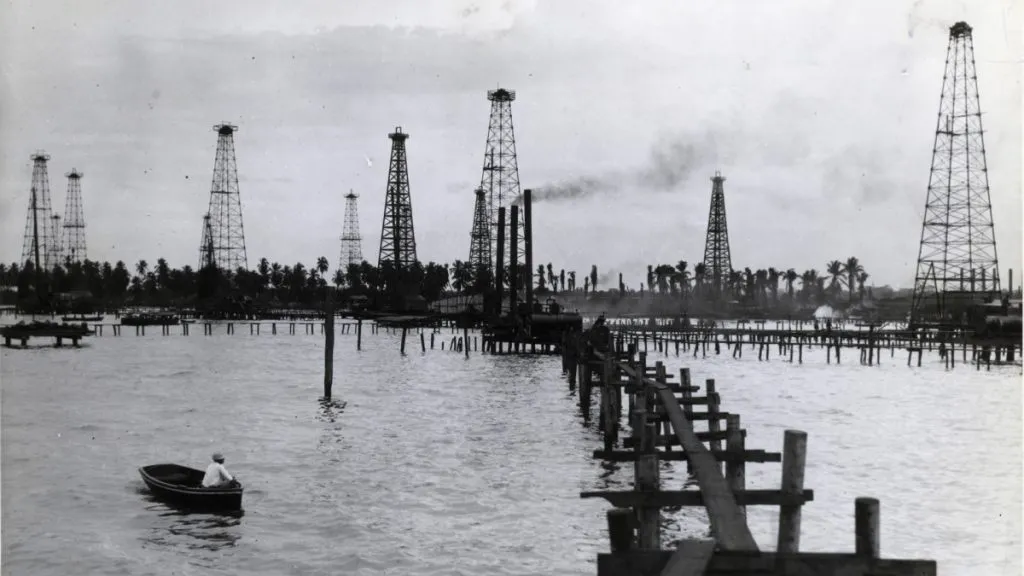
With your sculpture “Weaving Oil”—from the series “They Called It Mena,” which you exhibited in 2024 at Sorondo Projects in Barcelona and later at the Salón de Jóvenes with FIA (Ibero-American Art Fair), where it won a special mention—you use raw materials from Cabimas, with the symbolic weight of the industry and your own family history in Cabimas, to literally weave the material that “wove” the country. Are we Venezuelans people of oil, of ore, like the Mayans were people of corn? By weaving, do you reconstruct the origin of modern Venezuela, almost like the corn gods do in the Popol Vuh?

After La Rentrada and working the avocado seed to the limit, I wanted to pursue a counterproject with oil. ‘They Called It Mena’ was born from a desire to give this rock oil a rest, and to create “non-productive” projects with it. It’s a kind of farewell that seeks to reflect on the past, present, and future of the relationship between oil and humanity.
“Weaving Oil” is a piece that reflects on this collective identity, but from a very intimate perspective. In fact, the pieces that comprise it are made in the image of my grandmother and one of my aunts, who helped me untangle the oil threads when I made them in Cabimas.
In reference to the people of oil or corn, there’s one piece in particular, “Telurismos a Tres Tiempos,” (Tellurisms in Three Times) that directly explores this idea. It’s made of silk dyed with petroleum and covered with a plastic I make from corn starch. The piece seeks to explore Venezuelan identities in different times and realities. From a parallel universe in which Venezuela developed a strong sericulture industry (a failed project from the 1930s), to derivations of the Popol Vuh and our own identity as people of corn, but from a processed corn that refers to [food and intersection of nature and culture writer] Michael Pollan. And finally, reclaiming oil, and ourselves, as telluric entities. José Ignacio Cabrujas is part of the references here.

In “Venezuelan Petroleum for the South Bronx,” exhibited in the Bronx Museum collection, you allude to CITGO’s heating programs under Hugo Chávez and to energy philanthropy as a state foreign policy. The work shows a canvas, almost dirty, grimy with crude oil: Is it an anti-Shroud of Turin, representing the filth and turbidity of Venezuelan petro-diplomacy?
My work always plays with ideas about the specificity of the site where it’s shown. In 2023, I was part of a fellowship with the Bronx Museum and then participated in the museum’s biennial in 2024. I kept returning to the idea of making a work that encapsulated this little-known relationship between Venezuela and the Bronx, one that uncomfortably disrupts certain logics regarding power. When I told the biennial curator about my proposal, she was first surprised because she wasn’t familiar with this story, and then excited for the same reasons I was.

You’ve transformed the algae bloom from Lake Maracaibo into threads to create sculptures with this organism: what symbolic narrative does it open about cleanliness, toxicity, energy, and the memory of oil?
These pieces are part of “Weaving the Post-Oil” (Tejiendo el Post-Petróleo), which is itself part of “They Called It Mena” (Lo llamaban Mena). I took samples with bottles I found at the lake because I already had an idea to do a series on the post-oil era.

Seeing the toxic algae (verdín) in Lake Maracaibo in person is a rather surreal experience. Fishermen continue to fish, and people continue to eat these fish. Local communities touch and/or consume verdín on a daily basis. Just as we are all microplastics, those who live around the lake are also verdín.
You’ve represented Venezuela abroad and resumed your practice in Venezuela, always centering around energy, food, and territory: within the tensions of geopolitics and the booms and busts of rentism. How do you envision a public pedagogy based on your materials—from avocado and algae blooms to oil—that contributes to a situated energy transition, without denying the oil heritage or romanticizing “green” solutions? What material is the future of Venezuela made of, according to María Elena Pombo?

When I participated in the London Design Biennale with Rentrada, one of the pieces, ‘Avocado Seed Harvest,’ consisted of a participatory action in which people brought avocado seeds to collect during the exhibition. I started with a few bags, and by the end of the exhibition, the avocados didn’t fit on the wall. The idea was to show the slow process of collecting and cooperating, in contrast to the speed of harvesting. My dream for Venezuela would be to be independent of a material and instead centered on actions.